Pet Sitting Contracts: The Complete Guide for 2026
Published on:
Jan 11, 2026

Lucas Stefanski
15 min read
The $5,000 dispute could have been prevented with one thing: a signed contract.
A pet sitter books a week-long Thanksgiving sitting for $700. The client returns two days early and demands a five-day refund. Without a clear cancellation policy in writing, the sitter loses $500 and learns an expensive lesson about operating without proper agreements.
This scenario plays out hundreds of times annually across the pet care industry. According to industry data, the pet sitting market reached $2.9 billion in 2025 and continues growing at 10-13% annually. As the industry professionalizes, proper contracts have shifted from "nice to have" to essential business protection.
This guide covers everything you need to know about pet sitting contracts: what to include, how to implement them, and how to avoid costly mistakes. You'll get a free downloadable template and learn modern solutions for signature collection and contract management.
Why You Need a Pet Sitting Contract

Running a pet care business without contracts is like driving without insurance. You might be fine for a while, but one incident can wipe out years of income.
A pet sitting contract protects both you and your clients by setting clear expectations for services, schedule, payment, and liability. It's not just about legal protection (though that matters). Contracts prevent misunderstandings before they become problems.
Consider what happens when expectations aren't documented. One client expects daily photo updates. Another assumes weekly is sufficient. Without a written agreement specifying communication frequency, a simple misunderstanding becomes a one-star review and lost referrals.
The numbers back this up. According to Pet Sitters International's Global Standards released in October 2025, "contracts and compliance" ranks among the core pillars of professional pet care. Providers without written agreements face significantly higher dispute rates and legal exposure.
Most insurance policies require contracts too. General liability insurance for pet sitters (averaging $42-45 monthly) often includes contract requirements in the fine print. Operating without one could void your coverage exactly when you need it most.
Beyond protection, contracts signal professionalism. They demonstrate you run a real business with clear policies and standards. This builds trust with clients who want to know their pets are in capable, professional hands.
Real scenarios where contracts matter:
Payment disputes: A client books week-long vacation sitting then returns two days early, demanding a refund. Your contract's cancellation clause saves you $500.
Liability issues: A pet escapes during a walk and causes a car accident. Your clear liability language protects you from a $15,000 claim.
Service disagreements: A client expects daily photos but you thought weekly updates were standard. Your contract specifies communication frequency, preventing conflict.
The alternative to having a contract isn't freedom or flexibility. It's risk and confusion that eventually catches up with you.
What to Include in Your Pet Sitting Contract

A comprehensive pet sitting contract needs ten essential components. Each serves a specific purpose in protecting your business and clarifying expectations.
1. Party Information
Start with basics: your business name and contact information, plus the client's full name, address, phone, and email. Include an alternate emergency contact who can make decisions if the primary client is unreachable.
This seems obvious, but clear identification prevents confusion. When you're caring for multiple clients, having complete contact details organized and accessible matters.
Example language: "This agreement is between Scritches Pet Care (Provider) and Jane Smith, 123 Main St, Anytown, State (Client)."
2. Pet Details and Medical History
Document everything relevant about the pets you'll care for: name, species, breed, age, weight, and microchip number. Include medical conditions, current medications, allergies, and behavioral notes like aggression, anxiety, or escape tendencies.
This component does double duty. It ensures you provide proper care while also protecting you from liability if a client fails to disclose important information like aggressive behavior or medical conditions.
Add the veterinarian's contact information so you can reach them quickly if needed. For multiple pets, use a table format to keep information organized and scannable.
3. Services and Schedule
Be specific about what you're providing. List the exact services (dog walking, overnight sitting, drop-ins), visit frequency and duration, and specific times or time windows.
Include special tasks like medication administration, feeding schedules, and exercise requirements. The more detailed you are here, the less room for "scope creep" where clients expect additional services not originally agreed upon.
Example language: "Provider will visit pet(s) once daily between 12-2pm for 30-minute visits including feeding, fresh water, litter box cleaning, and 15 minutes of play or exercise."
4. Location and Access
Specify the service address, key or lock code handling procedures, alarm system details, and any home rules like removing shoes or avoiding certain areas.
This protects both parties. You know how to access the home safely, and the client has documentation of what you're authorized to do.
Example language: "Client grants Provider access to home via key pickup at [location]. Provider agrees to secure the home and alarm system after each visit."
5. Payment Terms
State your rates clearly: price per service, deposit requirements (typically 50% for overnight bookings), payment due dates, accepted payment methods, and late payment fees if applicable.
Clarity here prevents the most common disputes. When everyone knows exactly what's owed and when it's due, payment runs smoothly.
Example language: "Services are billed at $35 per 30-minute visit. A 50% deposit is due at booking confirmation, with the balance due on the first day of service."
Modern pet sitting software like Scritches can automate invoice creation from bookings and track payment status, reducing manual work and preventing missed charges.
6. Cancellation Policy
This section causes the most disputes, so be crystal clear. Specify required notice for cancellations, your deposit refund policy, special rules for holiday bookings (often 21-day notice), and same-day cancellation fees.
Industry standard: cancellations within 24 hours are non-refundable. Holiday bookings often require 21-day notice for any refund.
Example language: "Cancellations with less than 24 hours notice forfeit the full payment. Holiday bookings require 21-day notice for deposit refund."
According to Time To Pet's industry research, strict cancellation policies reduce last-minute losses by 60%. Be consistent in enforcement, or your policy loses meaning.
7. Additional Fees and Surcharges
List extra charges: additional pet fees (typically $7-10 per pet), holiday surcharges ($5-10 flat or 25-50% increase), last-minute booking fees, extended stay rates, and medication administration fees.
This ensures pricing consistency and prevents surprise charges that damage client relationships.
Automated surcharge features in scheduling software ensure holiday rates and extra pet fees apply consistently without manual calculation or forgotten charges.
8. Liability and Insurance
Include a limitation of liability clause, mention your insurance coverage, clarify that clients assume risk for undisclosed pet behaviors, and address property damage responsibility.
This is your most critical legal protection. Consult an attorney for state-specific requirements, but a basic clause limits your exposure to unexpected claims.
Example language: "Provider maintains general liability insurance. Client assumes responsibility for damages or injuries caused by undisclosed aggressive behavior or medical conditions."
According to FindLaw, both pet sitters and pet owners can face liability if a pet causes property damage or bodily injury. Proper contract language helps clarify responsibilities.
9. Emergency Procedures
Authorize a specific dollar amount for emergency vet care without prior approval (typically $500-1,000). Specify the preferred veterinarian versus emergency clinic preferences, client availability expectations during service, and what constitutes an emergency versus routine issue.
This lets you act quickly when needed without fear of financial liability.
Example language: "Provider is authorized to seek veterinary care up to $1,000 without prior approval in life-threatening emergencies. Client will be contacted as soon as possible and assumes all veterinary costs."
10. Signatures and Dates
Both parties must sign and date the agreement. Include an electronic signature acceptance statement, since digital signatures are legally valid in all 50 states under the ESIGN Act of 2000.
Example language: "By signing below, both parties agree to these terms. Electronic signatures carry the same legal weight as handwritten signatures."
This makes the contract legally binding and enforceable.
Beyond the Basic Contract: Related Forms You Need

A service agreement is just one piece of your legal protection. Professional pet care operations need several complementary forms.
Vet Release Authorization: Some veterinarians require their own form authorizing them to provide care. Have a separate vet release or include it as an addendum, with specific authorization for the vet to treat your client's pet, your contact information so the vet can reach you, and the client's acknowledgment of financial responsibility.
Why separate? Many vets won't accept contract language and need their specific form. Having both protects you either way.
Emergency Contact Form: Include backup contacts if the primary client is unreachable: out-of-town emergency contact, nearby neighbor or family member who can assist, and alternative decision-maker for urgent situations.
Integrate this with your intake forms so emergency information is always accessible when you need it.
Key Handling Agreement: Document how keys will be secured during and after service, the expected key return timeline, lost key responsibility (who pays for rekeying), and security protocols.
Real scenario: A client demands $400 rekeying costs when they lost their own spare key. A clear key handling agreement prevented the sitter from paying.
Photo and Video Release: Get explicit permission before photographing pets. Cover social media usage rights, marketing material consent, and privacy expectations.
This protects you from privacy claims and is essential if you use Instagram or TikTok for marketing.
Medication Administration Consent: For pets requiring medication, create a separate form detailing specific medications and dosages, administration method and frequency, side effects to watch for, and extra liability protection for high-risk medications.
This is especially important for insulin, seizure medications, or other high-stakes treatments.
Multi-Pet Household Considerations: When caring for multiple pets, document separate profiles for each animal, individual medical authorizations for each, and interaction protocols like keeping pets separated or feeding separately.
Modern pet sitting software like Scritches centralizes all these forms in client profiles, so you can access emergency contacts, vet information, and signed agreements from your phone during visits.
Legal Considerations Every Pet Sitter Should Know
Contract law varies significantly by state, and what works in Texas might not comply in California.
State-Specific Requirements: Some states require specific liability language in service contracts. Independent contractor classification rules vary dramatically (California's ABC test is particularly strict). Consumer protection laws affect cancellation policies in some jurisdictions.
Action step: Research your state's requirements or budget $200-500 for an attorney to review your contract template. It's a one-time investment that prevents expensive mistakes.
Independent Contractor vs. Employee Implications: How you write your contract affects your tax classification. The IRS uses a 20-factor test focusing on "right to control" as the key differentiator.
Red flags that suggest employee status: requiring specific schedules, providing all equipment, controlling methods and processes, and restricting work for competitors.
Safe contract language: "Provider determines their own schedule and methods to complete agreed-upon services" versus "Provider must arrive at 8am daily and follow prescribed protocols."
Misclassification consequences are severe. The IRS can assess $10,000-25,000 per misclassified worker in back taxes and penalties. Your contract language matters.
Insurance Requirements and Contract Relationship: Standard general liability insurance for pet sitters costs $42-45 monthly and provides $1 million per occurrence, $2 million aggregate coverage. You'll likely need separate animal bailee coverage for injuries to pets in your care, since standard policies exclude "care, custody, and control."
Your contract must align with your insurance coverage. If your policy excludes certain services, your contract can't promise them. Some clients request certificates of insurance before booking, so keep your policy current.
According to Pet Care Insurance, proper coverage combined with clear contracts provides the strongest legal protection for professional pet sitters.
When to Consult an Attorney: Invest in professional legal review for your initial contract template ($200-500), state-specific compliance questions, dispute escalation beyond small claims court, and business structure decisions (LLC, corporation, sole proprietorship).
Pet Sitters International and the National Association of Professional Pet Sitters maintain lists of attorneys familiar with pet care industry issues.
Enforceability and Dispute Resolution: Contracts must be signed by both parties to be enforceable. Verbal agreements are nearly impossible to prove in disputes. Small claims court thresholds vary ($5,000-10,000 by state) for when you can pursue disputes without hiring an attorney.
Consider including a mediation clause for disputes over $500. This provides a middle ground between walking away and going to court.
Digital contracts with timestamps provide stronger evidence than paper agreements that can be disputed. Cloud-based systems maintain audit trails showing exactly when agreements were signed and by whom.
Industry Standards: Following PSI's Global Standards and NAPPS best practices strengthens your legal position. Courts often consider industry standards when evaluating liability disputes.
How to Actually Get Contracts Signed

Creating a great contract template solves half the problem. The other half is collecting signatures consistently.
Industry estimates suggest 30% of clients never return signed paper contracts. That's not a signature collection system; it's a liability disaster waiting to happen.
Timing: When to Collect Signatures
Before accepting bookings (Best Practice): Require signatures to confirm bookings. This prevents service without agreements, signals professionalism upfront, and ensures 100% compliance.
The con? Some clients expect instant booking without "paperwork." But this is a feature, not a bug. Clients who won't sign clear terms probably aren't clients you want.
At meet-and-greet (Common): Review contracts together in person, answer questions face-to-face, and build rapport while handling business.
This personal touch builds trust, but it delays bookings and relies on clients remembering to sign during an otherwise friendly conversation.
First day of service (Risky): Signing upon arrival for the first visit is awkward. You're already committed to the service before getting signature, and asking clients to sign at their doorstep is uncomfortable.
Use this only as a last resort if earlier methods failed.
Recommended approach: Require signatures before booking for new clients. For referrals from trusted sources, meet-and-greet signing is acceptable.
Methods Comparison: How to Collect Signatures
Paper Contracts: Print, client signs, you scan or photograph for records.
Pros: Familiar to everyone, no technology barriers, clients can keep physical copies.
Cons: 30% of clients forget to return them, easy to lose, difficult to store and organize, can't access while in the field, no version control when updating terms.
Real provider quote: "I spent more time chasing signatures than actually pet sitting. Clients would say 'I'll drop it off tomorrow' and never did."
Email PDF Contracts: Email PDF, client prints/signs/scans or uses PDF signing tools, and emails back.
Pros: Digital record, faster than postal mail, widely understood process.
Cons: Still requires client effort (printing, scanning, or using PDF tools), tracking who's signed is manual work, stored in scattered email threads instead of organized system.
E-Signature Services (DocuSign, HelloSign, Adobe Sign): Upload contract, send for signature, receive signed copy automatically.
Pros: Professional experience, legally binding (ESIGN Act compliant), automated reminder emails, centralized storage and audit trails.
Cons: Standalone tool not integrated with your booking system or CRM, monthly subscription ($10-25/user), clients receive separate email outside the booking flow.
Integrated Digital Agreements (Pet Sitting Software): Clients sign during online booking, contract automatically stored in their profile.
Pros: Seamless booking experience, no separate emails or tools needed, connected to client profile and booking records, version control for updates built-in, accessible from your phone during visits, can require signature before booking confirms.
Cons: Requires pet sitting software subscription, time investment to migrate from existing system.
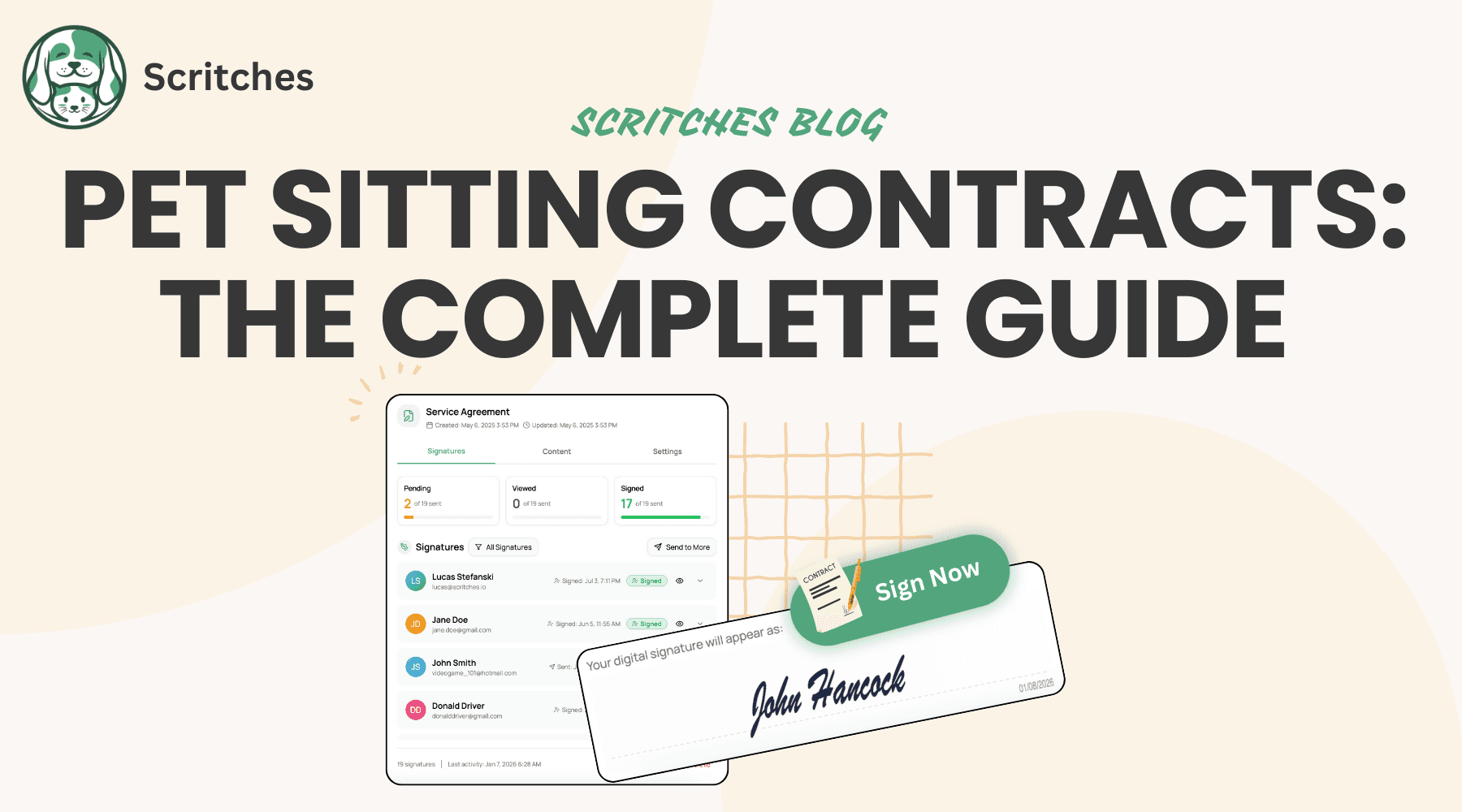
Scritches handles this by letting you upload your contract as a digital agreement. When clients book online through your booking page, they sign during checkout. The signed contract lives in their client profile where you can access it anytime, even from your phone during a visit.
Comparison Table:
Method | Setup | Client Compliance | Storage | Access | Version Control | Cost |
|---|---|---|---|---|---|---|
Paper | Low | 70% | Difficult | Poor | None | $0 |
Email PDF | Medium | 80% | Scattered | Medium | Manual | $0-10/mo |
E-Signature | Medium | 90% | Centralized | Good | Manual | $10-25/mo |
Integrated Digital | High (initial) | 95%+ | Automatic | Excellent | Automatic | Part of software |
Handling Client Objections
"Do I really need to sign something?"
Response: "My contract protects both of us by making expectations clear. It covers payment terms, cancellation policy, and emergency authorization. It's the professional standard, and my insurance requires it."
"Can we do this later?"
Response: "I'd love to get you on the schedule, and I just need your signature first to confirm the booking. It takes two minutes and then we're all set."
"This seems like a lot of legal stuff."
Response: "I know it looks detailed, but it's really just documenting what we've already discussed: your pet's information, visit times, and payment terms. I'm happy to walk through any sections you have questions about."
Follow-Up Strategies (for non-digital methods):
Day 1: Send contract with booking confirmation
Day 3: Friendly reminder email if not returned
Day 5: Text message nudge
Day 7: Phone call if service is approaching
E-signature services handle this automatically with built-in reminders.
Modern pet sitting software solves the follow-up problem entirely by requiring signatures before booking confirmation. This eliminates the chase-down process and ensures 100% compliance.
Common Contract Mistakes That Cost Pet Sitters Money
Real provider errors and their expensive consequences.
Mistake 1: No Contract at All
Scenario
A solo sitter operates on handshake agreements for two years. A client’s dog bites another walker on the trail. The sitter gets sued for $25,000. No contract means no liability limitation clause.
Cost
💸 $25,000 lawsuit plus attorney fees
Prevention
Even a basic contract with liability language would have limited exposure.
Lesson
⚠️ One incident can wipe out years of income.
Mistake 2: Using a Generic Service Agreement (Not Pet-Specific)
Scenario
A provider downloads a generic service contract template. A pet has a medical emergency, and the sitter takes them to the vet for a $1,200 bill. The client refuses payment, claiming they never authorized treatment.
Cost
💸 $1,200 out of pocket
Prevention
Pet-specific contracts include veterinary authorization limits and emergency procedures.
Lesson
⚠️ Generic templates miss industry-specific risks like emergency medical decisions.
Mistake 3: Starting Service Before Getting a Signature
Scenario
A client books holiday sitting. The provider starts service assuming the contract will be signed at the meet-and-greet. The client cancels after two days, owing $400. Without a signed contract, enforcement is difficult.
Cost
💸 $400 unpaid plus time pursuing payment
Prevention
Require signatures before the first visit.
Lesson
⚠️ “I’ll sign it later” becomes “I never agreed to those terms.”
Mistake 4: Lost Paper Contracts
Scenario
A provider stores signed contracts in a filing cabinet. A dispute arises six months later, and the contract can’t be found.
Cost
💸 $800 disputed payment lost
Prevention
Digitally store contracts with backups. At minimum, scan paper copies.
Lesson
⚠️ A contract only protects you if you can produce it.
Mistake 5: Outdated Contract Terms
Scenario
A provider updates a cancellation policy from 24-hour to 48-hour notice but forgets to update the contract. A client cancels with 36 hours’ notice and relies on the old terms.
Cost
💸 $175 cancellation fee uncollected
Prevention
Use version control to track which clients have current terms.
Lesson
⚠️ Old contracts create grandfather clause problems.
Mistake 6: No Deposit Requirement
Scenario
A provider books a $700 Thanksgiving sitting with no deposit. The client cancels two days before the holiday and the slot can’t be rebooked.
Cost
💸 $700 lost during the busiest week of the year
Prevention
Require 50–100% deposits for holiday bookings, non-refundable within 21 days.
Lesson
⚠️ Deposits protect income during high-demand periods.
Industry standard is 50% for regular bookings and 100% for holidays.
Mistake 7: Verbal Changes to a Written Contract
Scenario
A client asks to add medication administration. The sitter agrees verbally but doesn’t update the contract. The pet has a reaction, and the client claims the medication was unauthorized.
Cost
💸 $2,500 vet bill liability claim
Prevention
Document all service changes in writing. Email minimum, contract addendum preferred.
Lesson
⚠️ Verbal agreements don’t override written contracts.
Mistake 8: One Contract for All Service Types
Scenario
A provider uses an overnight sitting contract for dog walking. The contract includes key access language that feels excessive for daily walks.
Cost
💸 Lost client plus negative review
Prevention
Use separate contracts for overnights, walks, and drop-ins.
Lesson
⚠️ One-size-fits-all contracts damage trust.
Mistake 9: No Independent Contractor Language (For Companies)
Scenario
A pet sitting company hires sitters as independent contractors, but the contract includes employee-style control language. A state audit reclassifies contractors as employees.
Cost
💸 $50,000+ in back taxes, penalties, and unemployment insurance
Prevention
Have an attorney review independent contractor agreements.
Lesson
⚠️ Contract wording determines tax classification.
Mistake 10: Forgetting to Update Contracts After Policy Changes
Scenario
A provider changes payment timing but doesn’t update contracts. Clients pay based on old signed terms, creating disputes.
Cost
💸 Payment delays and operational confusion
Prevention
Use version control and automated contract updates.
Key takeaway
The cost of not having a proper contract far exceeds the 30 minutes it takes to create one.
Managing Contracts as You Grow
At 5 clients, paper contracts work fine.
At 15 clients, email and filing cabinets get messy.
At 30+ clients, manual tracking breaks down.
At 50+ clients, contract management becomes a full operational burden.
The version control problem
Imagine you update your cancellation policy from 24-hour to 48-hour notice. Which of your 45 clients have the old contract versus the new version?
Manual tracking methods: spreadsheet with columns for client name, contract signed date, version number, and renewal date? File naming conventions in Google Drive? Your memory?
Real provider story: "I changed my holiday surcharge from $5 to $10. Six months later, a Thanksgiving client insisted their contract said $5. I couldn't remember which version they signed. Lost the argument because I couldn't prove it."
Common solutions by business size
Manual tracking (15–30 clients)
Spreadsheets tracking client name, signed date, and contract version.
Pros: Free.
Cons: Error-prone and time-consuming.
Cloud storage + naming conventions (20–40 clients)
Folders by year with consistent filenames.
Pros: Searchable and backed up.
Cons: Still no visibility into versions.
Standalone e-signature tools (30–50 clients)
Provide timestamps and version history.
Pros: Professional and reliable.
Cons: Separate system and monthly cost.
Integrated pet sitting software (30+ clients)
Contracts linked to client profiles and bookings with automatic version tracking.
Pros: Scales cleanly with minimal manual work.
Cons: Subscription and migration effort.
Updating Terms for Existing Clients
Option 1: Universal Update (all clients at once):
Email everyone: "We've updated our terms, please sign the new agreement."
Pros: Everyone on the same contract quickly.
Cons: Friction with loyal clients, some may refuse.
Option 2: Gradual Update (at next booking):
Require new contract at next booking.
Pros: Less disruptive, natural timing feels reasonable.
Cons: Clients on different versions for months, tracking complexity.
Option 3: Grandfather Clause (legacy clients keep old terms):
Existing clients keep old terms, new clients get new terms.
Pros: Loyal client appreciation, smooth transition.
Cons: Two-tier system creates operational complexity.
Recommended approach: Gradual update (Option 2) for minor changes, universal update (Option 1) for major liability or legal updates.
Why digital contract management matters
Find contracts in seconds
Access terms from your phone during visits
Automatic version tracking
Signature proof with timestamps
No lost documents
More professional client experience
Rule of thumb
If you spend more than two hours per month managing contracts manually, a digital system has immediate ROI.
Cancellation Policies That Actually Work

Cancellation policy causes more contract disputes than any other section. Get this right, and you prevent most payment conflicts.
Industry Standard Cancellation Policies
For regular bookings:
24-hour notice: Full refund minus deposit
Same-day cancellation: No refund, full charge
Late cancellation (12-24 hours): 50% charge
No-show: Full charge
For holiday bookings (Thanksgiving, Christmas, New Year's):
21-day notice: Full refund minus deposit
7-21 day notice: 50% refund
Less than 7 days notice: No refund, full charge
100% deposit upfront (non-refundable)
Rationale: Holidays are your highest-demand periods. Last-minute cancellations cost you prime income opportunities that can't be replaced.
For overnight and extended bookings:
50-60% non-refundable deposit at booking
7-day cancellation notice for partial refund
Less than 7 days: Deposit forfeited
Weather exceptions: Case-by-case basis (hurricanes, blizzards)
How to Structure Deposits
Deposit amounts by service type:
Drop-in visits: 0-25% (low commitment)
Dog walking packages: 25% (recurring service)
Overnight sitting: 50-60% (blocks your calendar)
Holiday bookings: 100% (opportunity cost)
Payment timeline:
Deposit: Due at booking to secure dates
Balance: Due on first day of service (or before)
Alternative: Full payment upfront for bookings less than 7 days out
Deposits prevent frivolous cancellations and compensate you for blocked calendar time.
Handling Cancellation Disputes
"I had an emergency."
Response: "I understand emergencies happen. My cancellation policy is in the contract you signed. I'd be happy to work with you on the balance if you rebook within 30 days."
Compassion plus boundary: Acknowledge their situation but enforce your terms.
"I didn't know about the cancellation fee."
Response: "The policy is in Section 6 of our contract. I'm happy to review it with you. Unfortunately, I can't make exceptions as it's not fair to other clients who follow the policy."
Reference the contract: Your signed document is your protection.
"That's not fair, I'm canceling 48 hours early."
Response: "I appreciate the notice. My contract requires 72 hours for holiday bookings. Because it's Thanksgiving week, I've already turned down other clients for those dates."
Explain impact: Help clients understand your business reality.
Enforcement Best Practices:
Review policy during booking: "Just so you're aware, holiday bookings require 21-day notice for refunds."
Highlight in contract: Use bold or a separate section for cancellation terms
Send reminder: Email 7 days before holiday bookings: "Reminder: Cancellation deadline is tomorrow"
Be consistent: Enforce for everyone, or the policy loses all meaning
Document exceptions: If you make one, note it in the client record
What Happens If Client Refuses to Pay:
Small claims court (filing fee: $30-100)
Collections agency (keeps 25-50% of recovered amount)
Write off as bad debt (most common for amounts under $200)
Prevention: Require full payment upfront for future bookings from this client
Key Takeaway: A cancellation policy only works if you enforce it consistently. Being "nice" to one client undermines the policy for everyone.
Conclusion
Pet sitting contracts protect your business, clarify expectations, and demonstrate professionalism. They're not optional overhead; they're essential infrastructure for operating safely and successfully.
Key Takeaways:
Contracts protect both you and your clients from expensive misunderstandings
Include 10 essential components from party information to signatures
Complement your service agreement with related forms (vet release, emergency contacts, key handling)
Get signatures BEFORE service starts, preferably during booking
Digital contracts solve operational headaches around storage, version control, and accessibility
Avoid common mistakes like starting service unsigned, losing paper copies, or using outdated terms
Enforce cancellation policies consistently or they lose all meaning
Scale your contract management as you grow from manual methods to digital systems
Action Steps to Implement Today:
Download our free pet sitting contract template (below)
Customize it for your business rates, policies, and services
Get it reviewed by a local attorney ($200-500 one-time investment)
Implement a signature collection system (paper, email, or digital based on your client volume)
Require signatures before next booking for all current clients
Modern Software for Growing Businesses
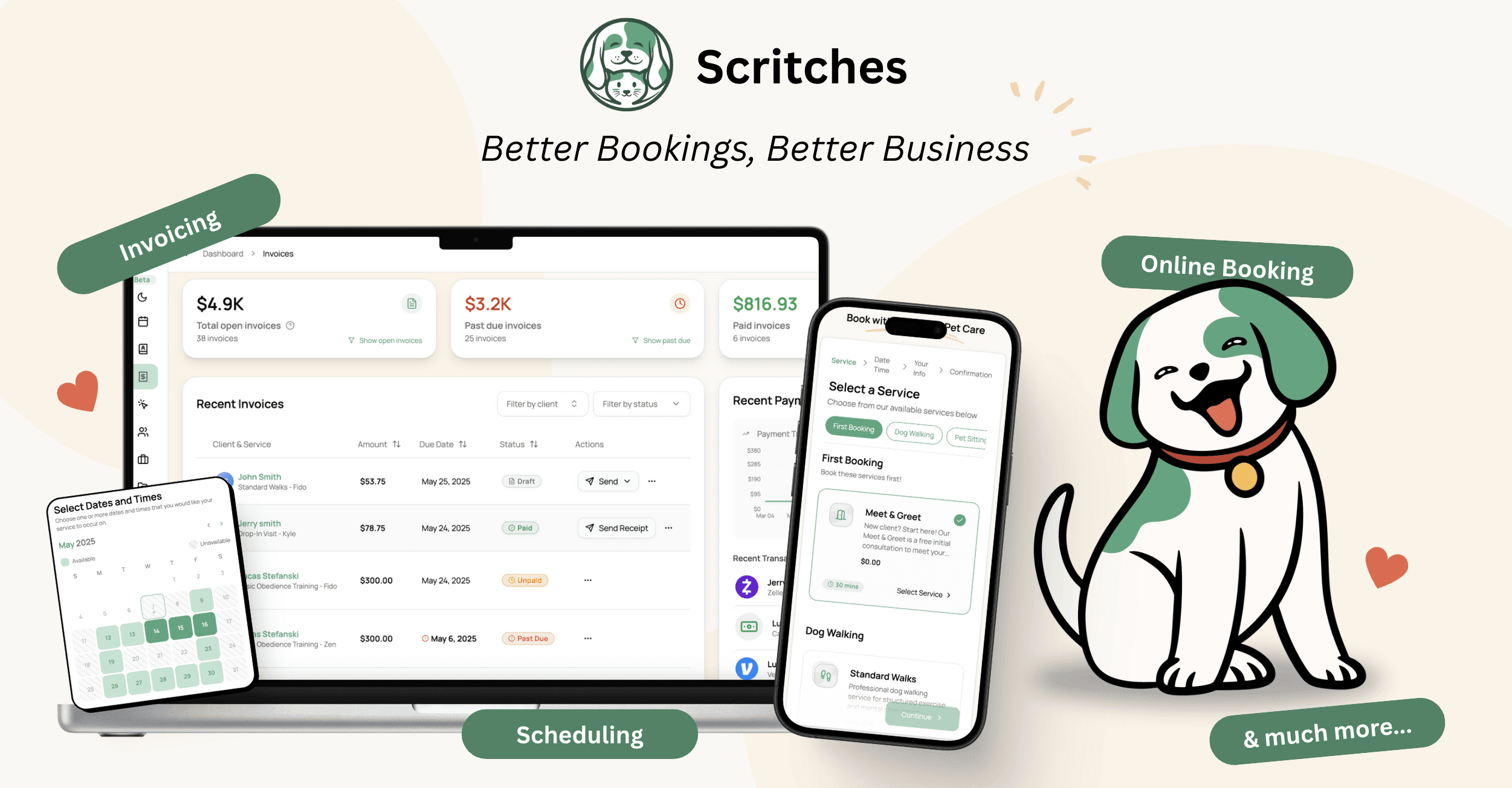
If you're managing 20+ clients or tired of chasing signatures and lost contracts, modern pet sitting software streamlines this entire process. Scritches stores contracts in client profiles, collects signatures during booking, and keeps everything accessible from your phone. You focus on caring for pets; the software handles the paperwork.
See how Scritches Digital Agreements work
Final Thought: The best time to create a contract was with your first client. The second-best time is today. Protect your business, respect your clients, and operate like the professional you are.
More
Read More Articles