How to Get More Pet Sitting Clients: 12 Strategies That Work (2026)
Published on:
Feb 23, 2026

Lucas Stefanski
12 min read
Most pet sitters who struggle with client growth don't have a talent problem. They have a consistency problem.
The pattern is familiar: you hand out flyers, post a few times on Instagram, maybe run a Facebook ad. Clients trickle in. You get busy doing the actual work. Marketing stops. A few weeks later, you're staring at a half-empty calendar wondering how to get pet sitting clients again.
You didn't start this business to become a marketing department. You started it because you're great with animals and wanted to build something on your own terms. The good news is that filling your schedule doesn't require a marketing degree or a big budget. It requires the right strategies, done consistently.
This guide covers 12 proven ways to get more pet sitting clients, organized by what actually moves the needle. We're starting with the strategies that cost nothing and compound over time, then working toward the ones that expand your reach. Whether you're a solo pet sitter, a dog walker building a route, or a small team looking to grow, these are the pet sitting marketing ideas that work in 2026.
Start with the Clients You Already Have
Every article about pet sitting advertising jumps straight to "get on social media" or "print some flyers." That's backwards.
The cheapest, fastest way to grow is to get more out of the relationships you've already built. Your current clients trust you with their pets. That trust is worth more than any ad.
Why Retention Beats Acquisition
Acquiring a new client costs five to seven times more than keeping an existing one. For pet sitters, the math is even more lopsided. A new client requires a meet-and-greet, intake forms, key exchanges, and a learning curve with their pet. A returning client just books.
Repeat clients also mean predictable income. If you have 15 clients who each book twice a month, that's a baseline you can count on. You don't need 100 one-time clients. You need 20 to 30 loyal ones.
So before you spend a dollar on advertising, ask yourself: are you doing everything possible to keep the clients you have? That means showing up on time, communicating clearly, and going a little further than expected. Something as simple as sending a pet report card with photos after every visit can be the thing that turns a one-time booking into a recurring one.
Turn Happy Clients into Your Sales Team
According to Pet Sitters International, word of mouth is the number one marketing channel for pet sitting businesses. That's not surprising. Pet owners talk to each other at the dog park, at the vet, and in neighborhood group chats. One genuine recommendation goes further than any ad you could run.
The problem is that most pet sitters wait passively for referrals. Here's how to be more intentional about it:
Ask at the right moment. The best time to ask for a referral is right after a client tells you how happy they are. "That means a lot. If you know anyone who needs pet care, I'd love the introduction" is natural and low-pressure.
Make it easy. Give clients a simple link or card they can share. Something like "Send this to a friend and you both get $15 off your next booking" removes the friction.
Offer meaningful incentives. A free visit, a discount on their next booking, or a donation to a local shelter in their name all work well. Pick what fits your brand.
A simple referral program can bring in two to three new clients per month without spending anything on ads.
Collect Reviews on Autopilot
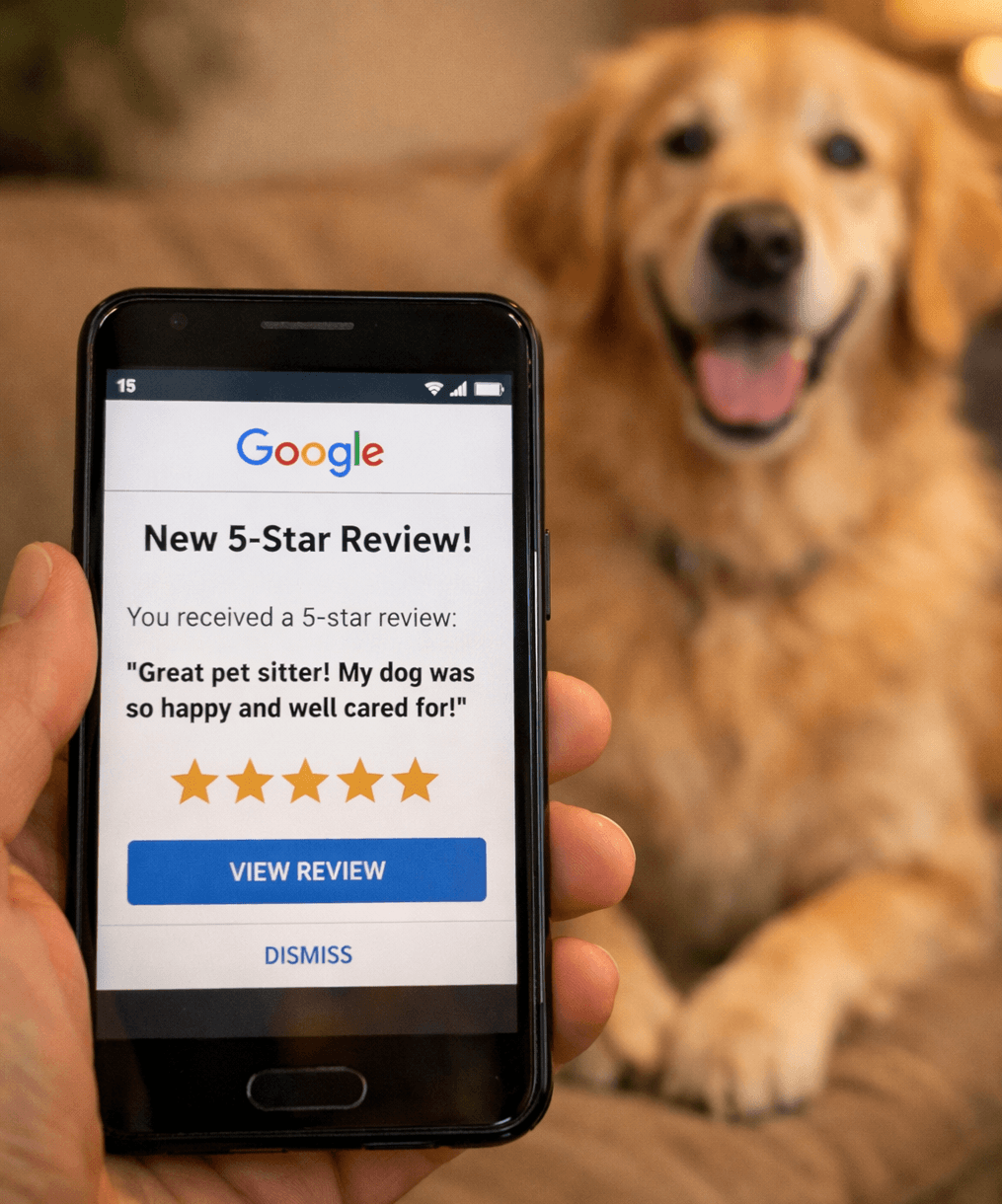
Reviews are the currency of trust for pet sitters. When someone searches for a pet sitter in their area, they're looking at two things: proximity and reviews. A profile with 40 five-star Google reviews will get the call over one with three reviews every single time.
BrightLocal's research found that 98% of consumers read online reviews for local businesses, and 76% read them "regularly." For a trust-dependent service like pet sitting, this matters even more. Pet owners are handing over their house keys and their animals. They want proof that you're reliable.
Here's where to focus your review efforts:
Google Business Profile -- This is the most important platform for local visibility. Google reviews show up directly in search results and Maps.
Nextdoor -- Hyperlocal and trusted. Nextdoor recommendations carry serious weight in neighborhood decisions.
Yelp -- Still relevant in many markets, especially in metro areas.
The biggest challenge isn't getting five-star service. You're already doing that. It's remembering to ask. The best approach is to automate it. Send a review request right after a booking is completed, when the client is happiest and the experience is fresh. Tools like automated review requests take this off your plate entirely. You finish the visit, the client gets a friendly nudge, and the reviews accumulate without you lifting a finger.
Build a Local Online Presence That Works While You Walk
Pet sitting is a local business. The people who will hire you live within a 10 to 20 mile radius. Your online presence needs to be built for local discovery, not global reach.
Google Business Profile: The Free Client Magnet
If you do one thing after reading this article, make it this: set up and optimize your Google Business Profile (GBP). It's free, and it's how most pet owners find local sitters.
When someone searches "pet sitter near me," Google shows a map pack with three local businesses before any website results. Those spots are prime real estate, and they're driven almost entirely by your GBP listing.
Here's how to optimize yours:
Pick the right category. Your primary category should be "Pet Sitting Service." Add secondary categories like "Dog Walker" or "Pet Boarding Service" if they apply.
Define your service area. List every city, neighborhood, or zip code you cover. Be specific.
Add photos. Upload photos of yourself with pets (with client permission), your branded materials, and your vehicle if you use one. Google has noted that listings with photos tend to get significantly more requests for directions and website clicks than those without.
Post weekly updates. GBP lets you publish short posts (think mini blog entries). Share a quick pet care tip, a seasonal reminder, or a happy pet photo every week. This signals to Google that your profile is active.
Respond to every review. Thank positive reviewers by name. For the rare negative review, respond professionally and offer to make it right. Future clients read your responses as closely as the reviews themselves.
Your Website and Booking Page
Your website doesn't need to be complicated. It needs to answer three questions fast: what services do you offer, what does it cost, and how do I book?
A surprising number of pet sitters still rely on "text me" or "send an email" as their booking method. That works when you have five clients. At 20 or 30, it becomes a bottleneck. Worse, it looks unprofessional to new clients who are comparing you against competitors with polished online booking.
A professional online booking page that shows your services, availability, and pricing upfront does two things. First, it removes friction. Clients can book at midnight after deciding they need a sitter for next weekend. Second, it builds credibility. A clean booking experience tells a potential client that you run a real business, not a side hustle.
If you already have a website, make sure it includes:
Your services and pet sitting rates listed clearly
A booking link or embedded booking page
Client testimonials or a link to your Google reviews
Your service area
A short bio with a photo of you (not just pets)
If you don't have a website yet and you're starting your pet sitting business, a booking landing page with your services, pricing, and availability can work as your entire web presence until you're ready for a full site.
Nextdoor and Local Facebook Groups
Nextdoor is quietly one of the best platforms for pet sitters. It's hyperlocal, trusted, and full of people asking their neighbors for recommendations. If you're not active there, you're missing easy leads.
The key is to show up as a helpful neighbor, not a spammer. Here's what works:
Respond to recommendation requests. People post "looking for a pet sitter" on Nextdoor constantly. Be the first to reply with a brief, friendly response.
Share genuinely useful content. Post about local pet safety alerts, seasonal tips (like keeping dogs cool in summer or safe on the 4th of July), or a lost pet sighting. This builds your reputation before anyone even needs a sitter.
Don't hard-sell. One self-promotional post per month is plenty. Let your helpfulness do the selling.
The same approach works in local Facebook groups. Join three to five groups in your area (neighborhood groups, pet owner groups, local parenting groups) and spend 15 minutes a day engaging. When someone asks for a pet sitter recommendation, you want other group members to tag you before you even see the post.
Pet Sitting Advertising and Marketing That Actually Pays Off
Once your retention, referrals, and local presence are working, it's time to expand your reach. This is where pet sitting advertising ideas and paid marketing come into play. The key is knowing where to advertise pet sitting services and picking the channels that match your budget and your market.
Google Ads for Pet Sitters and Dog Walkers
If you're trying to figure out how to get dog walking clients or pet sitting clients through paid channels, Google Ads can work well because the intent is strong. Someone searching "pet sitter in [your city]" is actively looking for your service right now.
Two options to consider:
Google Local Service Ads (LSAs) -- These appear at the very top of search results with a "Google Guaranteed" badge. You pay per lead (not per click), typically $15 to $30 per lead. You need to pass a background check to qualify. For pet sitters in competitive markets, LSAs can be worth the investment.
Standard Google Search Ads -- More flexible but requires more management. Budget $5 to $15 per day and target specific service-area keywords like "dog walker [city name]" or "pet sitter near [neighborhood]." This applies equally to dog walker marketing as it does to pet sitter advertising.
If your budget is tight, skip paid ads entirely and focus on the free strategies above. Google Ads are a multiplier, not a starting point.
Social Media: Instagram, Facebook, and TikTok
Social media for pet sitters works best when you follow the 80/20 rule: 80% content people actually want to see, 20% about your business.
The 80% is easy because you work with adorable animals every day. Post happy dogs mid-walk, a cat curled up on the couch, a goofy moment from a visit. Pet content is inherently shareable.
For the 20%, share things like:
A new five-star review screenshot
Seasonal booking reminders ("Holiday bookings are filling up!")
A quick tip about pet care
A behind-the-scenes look at your day
You don't need to be on every platform. Pick one or two where your ideal clients spend time and be consistent. For most pet sitters, Instagram and Facebook cover it. If you enjoy short-form video, TikTok and Reels can get your content in front of a much larger audience since pet content performs exceptionally well on both.
Pro tip: sharing pet report cards on social media (with client permission) is a low-effort way to create content and show potential clients the quality of care you provide.
Old-School Pet Sitter Advertising That Still Works
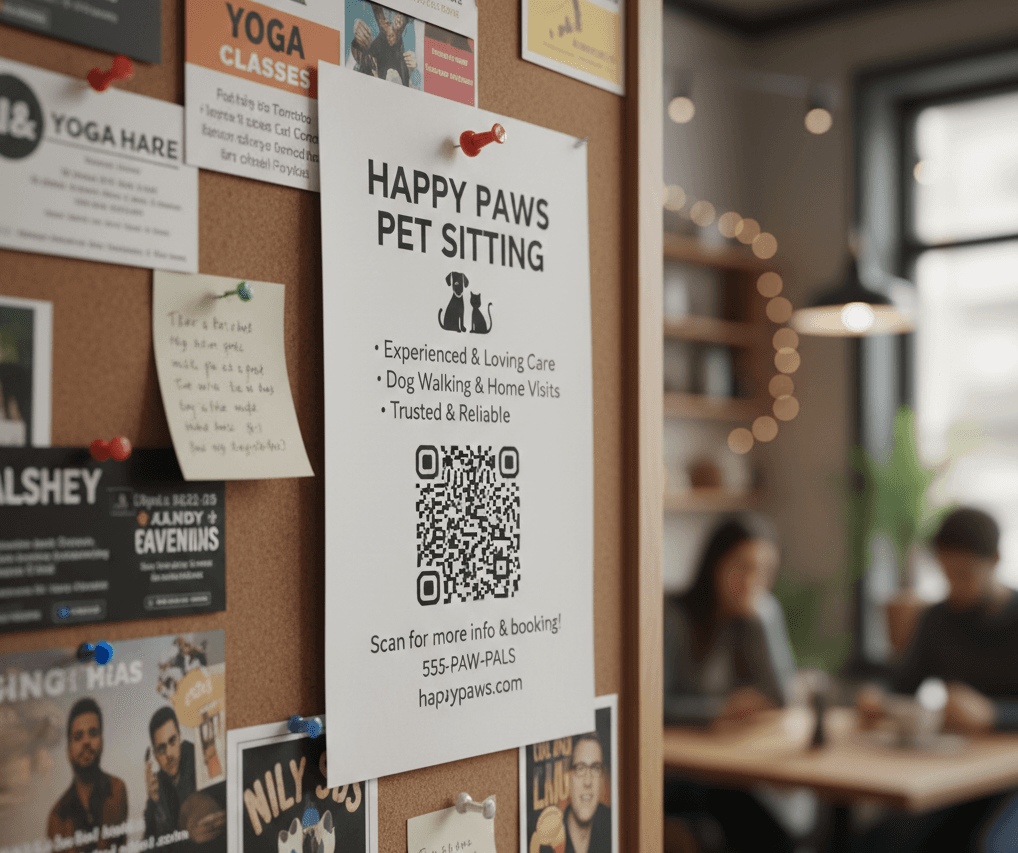
Digital isn't everything. For a local business like pet sitting, physical advertising still pulls its weight.
Flyers -- Place them at vet offices, pet stores, groomers, dog parks, community boards at coffee shops, and pet-friendly apartment complexes. Include a QR code that links directly to your booking page. Replace them monthly since they get taken down or covered up.
Business cards -- Keep them on you at all times. When someone at the dog park asks what you do, hand them a card. It's a small thing, but it turns a casual conversation into a potential client.
Strategic partnerships -- This is the most underrated pet sitting advertising strategy. Build relationships with:
Veterinarians -- Offer to leave cards or flyers at their front desk. Many vets are happy to recommend trusted sitters to their clients.
Groomers -- Same idea. Their clients are pet owners who value professional care.
Pet stores -- Some have community boards. Others will let you leave a stack of cards by the register.
Realtors -- New homeowners with pets often need a sitter. Ask local realtors to include your card in their welcome packets.
Drop off a small gift (homemade dog treats, a branded pen) with your materials every couple of months to stay top of mind.
How to Promote Your Pet Sitting Business Beyond the Marketplaces
If you're wondering how to market a pet sitting business in a world where Rover and Wag exist, the answer is to lean into what makes you different.
The Independent Sitter Advantage
Marketplace sitters are interchangeable. Clients browse profiles, pick someone based on price and proximity, and the platform takes a 20% cut. There's no brand loyalty because the loyalty belongs to the platform, not the sitter.
As an independent sitter, you own the relationship. That means:
You set your own rates without losing a chunk to a middleman. A $50 overnight on Rover nets you $40. The same booking through your own system nets you $50. Over a year, that difference adds up fast. You can calculate exactly how much you're leaving on the table.
You build a real brand. Clients remember your name, not an app icon. They refer friends to you specifically.
You control the experience. Your booking flow, your communication, your policies. No algorithm decides your visibility.
Look Professional Without a Big Budget
The main thing marketplace apps provide is a polished, trustworthy interface. Clients feel safe booking through Rover because it looks professional. You need to match that perception independently.
That means having:
A clean booking page where clients can see your services and request care
A client portal where pet owners can view bookings, invoices, and their pet's info
Professional intake forms and service agreements that set clear expectations
Branded communication that looks polished, not cobbled together from texts and Venmo requests
You don't need to build any of this from scratch. Pet sitting software handles the professional layer so you can focus on the actual pet care.
Make It a System, Not a Sprint
The biggest marketing mistake pet sitters make isn't choosing the wrong strategy. It's doing something for two weeks, getting busy, and stopping. Every strategy on this list works better with consistency than with intensity.
The 30-Minutes-a-Week Marketing Routine
You don't need hours. You need a simple routine you can stick to between walks.
Weekly (15 minutes):
Respond to any new Google or Nextdoor reviews
Post one photo or tip on social media
Check if any Nextdoor or Facebook group posts mention pet sitting
Monthly (15 minutes):
Ask your two or three happiest clients for a referral
Refresh flyers at vet offices and pet stores
Review where your last few new clients came from
That's it. Thirty minutes a week, consistently, will outperform any marketing blitz you do once and forget.
Track What Brings You Clients
Ask every new client one simple question: "How did you find me?"
Keep a basic tally. After three months, you'll have a clear picture of what's actually working. Maybe it's Google reviews driving 60% of your leads. Maybe it's that one vet office that keeps recommending you. Whatever it is, double down on it and stop spending time on channels that aren't producing.
This data also helps you decide when to invest. If you know Google is your top channel, spending $10 a day on Google Ads makes a lot more sense than guessing.
Fill Your Schedule Without Burning Out
Pet sitting marketing doesn't have to mean doing 30 things at once. It's about doing the right three to four things consistently.
Start here:
Keep your current clients happy. Send report cards, communicate proactively, and make rebooking effortless.
Build your review engine. Get to 20+ Google reviews and watch how much easier new client acquisition becomes.
Own your local presence. Optimize your Google Business Profile and show up in the places pet owners already gather.
Look professional. A clean booking page and organized client experience separates you from every "text me to book" sitter in your area.
You can add flyers, social media, partnerships, and paid advertising on top of that foundation as your business grows. But the foundation is what matters most.
The American Pet Products Association reports that US pet industry spending topped $150 billion in recent years, and pet services is one of its fastest-growing segments. The demand for professional pet sitters and dog walkers isn't slowing down. The clients are out there. You just need a system to help them find you, and a pet sitting business worth coming back to.