Rover's New Tiered Fees (+ Why Clients Now Cost You 30%)
Published on:
Jun 25, 2026
Lucas Stefanski
8 min read

Rover is piloting new tiered fees that tie your service fee to how much booking history you have with each client. The headline most sitters miss: new clients now start at a 30% fee, not the flat 20% you're used to. Your fee drops as your history with a client grows, but until it does, Rover takes a bigger cut of every booking with someone new.
That's the whole change in one breath. The rest of this page is what it means for your actual paycheck, who comes out ahead, who comes out behind, and the questions sitters keep getting wrong about it.
What changed, and where it's live
For years, Rover's sitter fee was simple: a flat 20% per booking, so you kept 80% of your listed rate. The new structure replaces that single number with three tiers. Instead of one fee for everyone, your fee now depends on the total dollar value of your booking history with each individual client.
This is a pilot, not a nationwide rollout. Right now it's automatic for sitters in and around three metro areas: Seattle, Tacoma, and Bellevue in Washington; Chicago, Naperville, and Elgin in Illinois; and Dallas, Fort Worth, and Arlington in Texas. If you sit in one of those cities, you're already in it and you can't opt out. If you don't, your fee is still the flat 20% for now, though Rover has said it may expand the program as it gathers feedback.
Two more limits worth knowing: grooming and training services are excluded from the new fee experience, and the change only affects what sitters earn. Pet owners pay the same as before and never see your tier.
Rover is running a parallel pilot in Canada with the same three-tier setup but slightly lower thresholds (30% under $500, 15% from $500 to $999, 10% at $1,000 or more) in cities including Vancouver, Calgary, Ottawa-Gatineau, Québec, Regina, Saskatoon, and Nanaimo. The rest of this guide uses the US numbers.
How the three Rover relationship tiers actually work
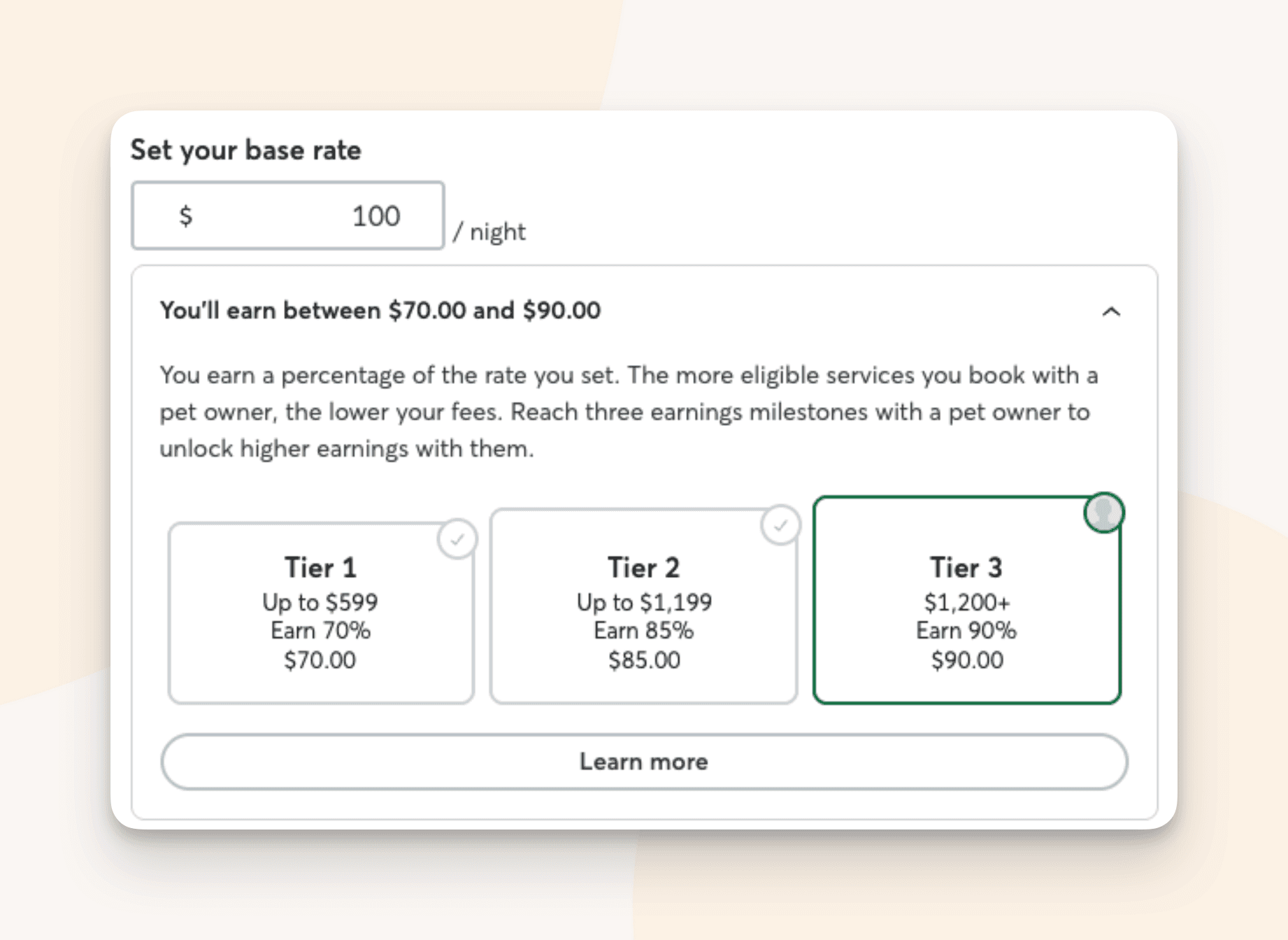
Rover calls these "relationship tiers," and the logic is that the longer you work with a client, the less Rover takes. Here are the confirmed US thresholds:
Tier | Booking history with that client | Your service fee | You keep |
|---|---|---|---|
Tier 1 | $599 or less | 30% | 70% |
Tier 2 | $600 – $1,199 | 15% | 85% |
Tier 3 | $1,200 or more | 10% | 90% |
A few mechanics that change how this plays out:
Progress is tracked per client, not per pet or service. Every completed booking from the same client counts toward the same total, whether it's boarding, drop-ins, or walks. Past bookings count too, so any history you've already built carries over.
Tips don't count toward progress. Only the booking subtotal moves you up the tiers.
A single booking can straddle two tiers. If a booking pushes your history past a threshold, Rover applies each tier's fee to the portion of the subtotal that falls in that tier. So if your first booking with a client is $650, the first $599 is charged at the Tier 1 rate and the remaining $51 gets the lower Tier 2 rate.
What this means for your take-home pay
This is where the framing Rover uses ("earn more with repeat clients") and the reality a sitter feels can point in opposite directions. The reality depends entirely on the client.
Take a new client booking a $400 stay. Under the old flat 20%, you kept $320. Under Tier 1's 30%, you keep $280. That's $40 gone on a single booking with someone you just started working with, on money you used to keep more of.
Now run a loyal client who's booked you for years and is sitting in Tier 3. A $400 booking with them used to net you $320 at the old 20%. At the Tier 3 rate of 10%, you keep $360. That's a real, meaningful gain, and it's the case Rover leads with.
So both stories are true. If your business runs on a handful of high-value repeat clients, this structure can put more money in your pocket. If it runs on a steady stream of new or one-off clients, you're now paying 30% on exactly the bookings you used to pay 20% on. It's worth revisiting what you charge for each service with the new cut in mind, since a fee you set against the old 20% no longer nets what it used to.
The trouble is that "what tier am I in with this specific client" isn't something you can eyeball across a full client list. See your take-home under each tier with the numbers from your own bookings before you assume the change helps or hurts you.
That $40 isn't a one-time hit. It repeats on every booking with that client until their history with you clears $600. The clients you find are yours, but on Rover you keep renting them back one booking at a time. On your own booking page, a new client costs you 0% in marketplace fees from booking one. See how sitters keep 100% with Scritches →
Who wins and who loses under the new structure
The structure quietly rewards one kind of business and penalizes another.
It rewards sitters who concentrate on a few long-term, high-spend clients. Regular boarders, weekly dog walkers, anyone whose history with a single client clears $1,200 and lands in Tier 3. For them, the effective fee drops by half compared to the old flat rate.
It penalizes sitters with high client turnover or lots of first-time bookings. New sitters building a book of business, anyone in a travel-heavy market with one-off vacation bookings, or sitters whose clients spread small amounts across many providers. Every one of those new relationships starts at 30%, and plenty never reach the spending level where the fee comes back down.
There's a quiet irony in the design. By rewarding Tier 3, Rover is admitting that your repeat clients are the valuable ones. Those are exactly the clients you don't need a marketplace for. You already did the hard part: you found them, you earned the trust, you do the work. The only thing the platform still does on a repeat booking is take a cut.
Rover's tiers vs. owning the client yourself
Here is the same client relationship viewed two ways. Same sitter, same work, different ownership.
Rover (new tiers) | Owning the client on Scritches | |
|---|---|---|
A brand-new client's first booking | 30% fee | 0% marketplace fee |
Every repeat booking after | 30% until $600, then 15%, then 10% | 0% marketplace fee, every time |
Who owns the client relationship | Rover | You |
Does the fee reset on a new client | Yes, back to 30% | There is no marketplace fee to reset |
Card processing | Included in the cut | Standard payment processing still applies |
You can keep using Rover, or anywhere else, to get discovered. The point is that once a client is yours, you shouldn't have to keep paying a marketplace to book them again.
How to actually escape the new-client fee
You can't opt out of the pilot if you're in a pilot city, and you can't skip the climb to Tier 3. But you can change who owns the relationship, which is the only thing that actually moves the fee to zero. Three steps:
Keep getting discovered wherever works. Rover, word of mouth, your neighborhood, your existing reviews. Finding new clients is the one thing a marketplace is genuinely good for.
Move repeat clients to your own booking page. Once someone has booked you once, send them your own link. They book, pay, and rebook with you directly, no 30% first-booking tax, no tier to climb.
Keep 100% and own the relationship. The client is yours from booking one. A new client is just a new client, not a new 30% fee.
Run the math on one regular. Say a client books $2,000 of sitting with you over a year. On Rover's new tiers, the blended cut works out to roughly $350 in fees on that single relationship. Take that same client direct and that's $350 you keep, on one client, in one year. Multiply by your book of regulars and the new structure stops being your problem.
Common questions sitters are getting wrong
A few things worth clearing up, because the confusion is spreading faster than the facts:
Clients don't see your tier and don't pay more. Relationship tiers are visible only to you. Owner pricing and the owner booking fee are unchanged, so nothing about how clients book with you changes.
Tips don't move you up the tiers. Progress is based on the booking subtotal only. A generous tipper still helps your income, just not your tier.
It doesn't touch Star Sitter status. This is a separate earnings structure. Your Star Sitter eligibility, Trust & Safety support, and the Rover Guarantee all work the same as before.
The clock resets with every new client. This is the part that stings. Your tier is per relationship, so a brand-new client starts you back at 30%, no matter how many other clients you've taken to Tier 3.
Frequently asked questions
Is Rover raising fees to 30%? For new clients in the pilot, effectively yes. Your fee starts at 30% on booking history under $600 with a given client, compared to the old flat 20%. It then drops to 15% and eventually 10% as your history with that client grows.
What are Rover's relationship tiers? They're a three-level fee structure based on your total booking history with each client: 30% under $600, 15% from $600 to $1,199, and 10% at $1,200 or more. The more you book with one client, the less Rover takes.
Is the tiered fee change nationwide? Not yet. It's a pilot currently limited to sitters in and around Seattle, Chicago, and Dallas. Rover has said it may extend the program to more sitters over time, but most sitters are still on the flat 20% fee.
Do tips count toward Rover fee tiers? No. Only the booking subtotal counts toward tier progress. Tips are excluded, though you still keep 100% of them.
How do I avoid Rover's 30% fee on new clients? You can't opt out if you're in a pilot city. The only structural way around the new-client fee is to own the client relationship yourself, so a new client isn't a new 30% fee. Many sitters use Rover to find clients, then run repeat bookings through their own system like Scritches, where there's no marketplace cut on any booking. If you're weighing platforms, it's also worth seeing how Rover's cut compares to Wag's before you commit to either.
Will Scritches find me new clients like Rover does? No, and that's the honest line. Scritches isn't a marketplace, so it won't put your profile in front of strangers. What it does is let you keep every client you find anywhere, run your own bookings, and stop paying a cut on the relationships you already built. Use a marketplace for discovery, use Scritches to own what follows.
The bigger takeaway
The detail that outlasts the pilot is this: "every new Rover client restarts you at 30%, and there's no way to skip the climb." For sitters whose growth depends on new clients, that's a permanent tax on exactly the thing that grows a business.
The way off the treadmill is owning the relationship from the first booking, so a new client is just a new client and not a new 30% fee. That's what Scritches is built for: keep the clients you find anywhere, run your own bookings, and stop losing a slice of every new relationship to a marketplace cut. If you're earlier in the journey, our guide on how to start a pet sitting business walks through setting up on your own terms from day one.
Free to start, no card required. Keep 100% of your repeat clients and stop paying more the longer you stay.
More
Read More Articles